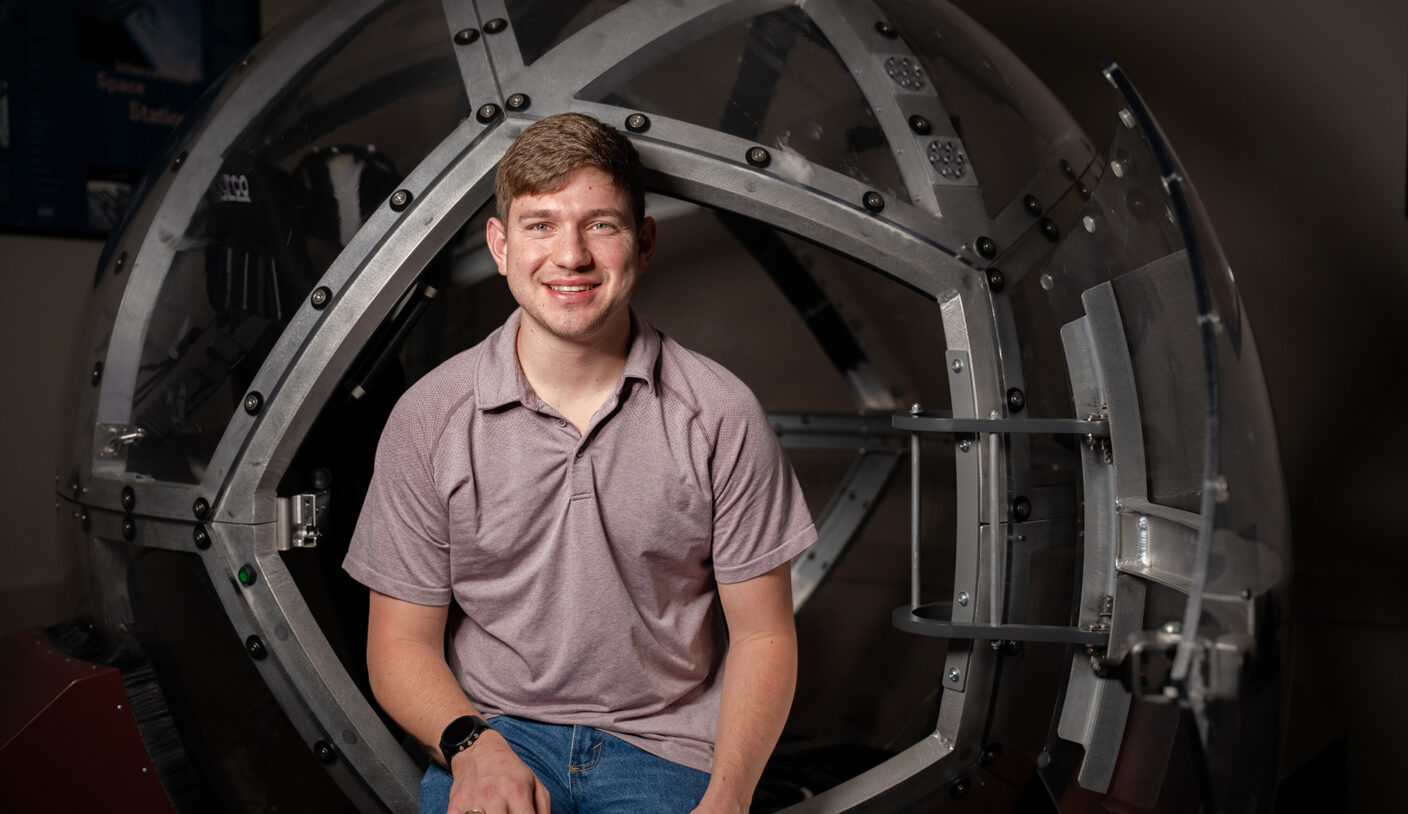
John Hayes grew up just 45 minutes from NASA Johnson Space Center, where his grandfather worked during the Apollo era.
Hayes enrolled at Texas A&M University in 2016, eventually landing on a pre-med track. His coursework gave him an understanding of the human body on different scales — from the cellular and systemic levels to the body as a whole.
Many students decide on pre-med before beginning their undergraduate coursework — Hayes didn’t commit until after his sophomore year. He was already planning a gap year because of medical school’s once-a-year application cycle, and his plans were further delayed when the COVID-19 pandemic pushed back his MCAT exam.
Hayes took a position in a neuroscience research laboratory at Baylor College of Medicine to gain more experience before applying to medical school for a fall 2022 start date. But when it came time to apply for medical school in the summer of 2021, Hayes realized he no longer had a passion for medicine.
“I realized that if I’m going to spend the rest of my life working on something, it should be something I’m really excited about,” said Hayes. “At 23 years old, it is not too late to pivot.”
He recalls watching live rocket launches and space movies, like Interstellar and Apollo 13, during the pandemic.
“Taking a gap year was huge in my decision to pursue engineering. It was the first time in four years that I actually had some free time to explore other interests outside of medicine, and I started to get really excited about space,” Hayes said.
Instead of applying to medical school, Hayes applied to Texas A&M to pursue a master’s degree in industrial engineering. Once he began his coursework, Hayes quickly realized that he wanted to go beyond a master’s degree to pursue a Ph.D. as well.
Hayes’ diverse experiences and the people he met along the way helped chart his trajectory to aerospace engineering. He decided to pursue engineering with a focus in bioastronautics, where his background in biology would prove useful.
The decision paid off.
Today, Hayes is a NASA Space Technology Graduate Research Opportunities (NSTGRO) fellow and a Ph.D. candidate in aerospace engineering.
The NSTGRO fellowship annually awards graduate students with funding for projects addressing knowledge gaps across different areas of space research. Hayes’ project combines biology and engineering to examine the effects of microgravity on astronauts’ abilities to pilot and dock spacecraft. Astronauts’ time in space is valuable, and extended periods of disorientation could delay tasks that require manual control.
Microgravity disrupts the fluid in astronauts’ inner ears — impacting balance and spatial awareness — causing disorientation that can take days to resolve.
Using electrical signals, called galvanic vestibular stimulation (GVS), Hayes studies the effects of disorientation on Earth, with hopes that GVS can help astronauts acclimate to working in microgravity.
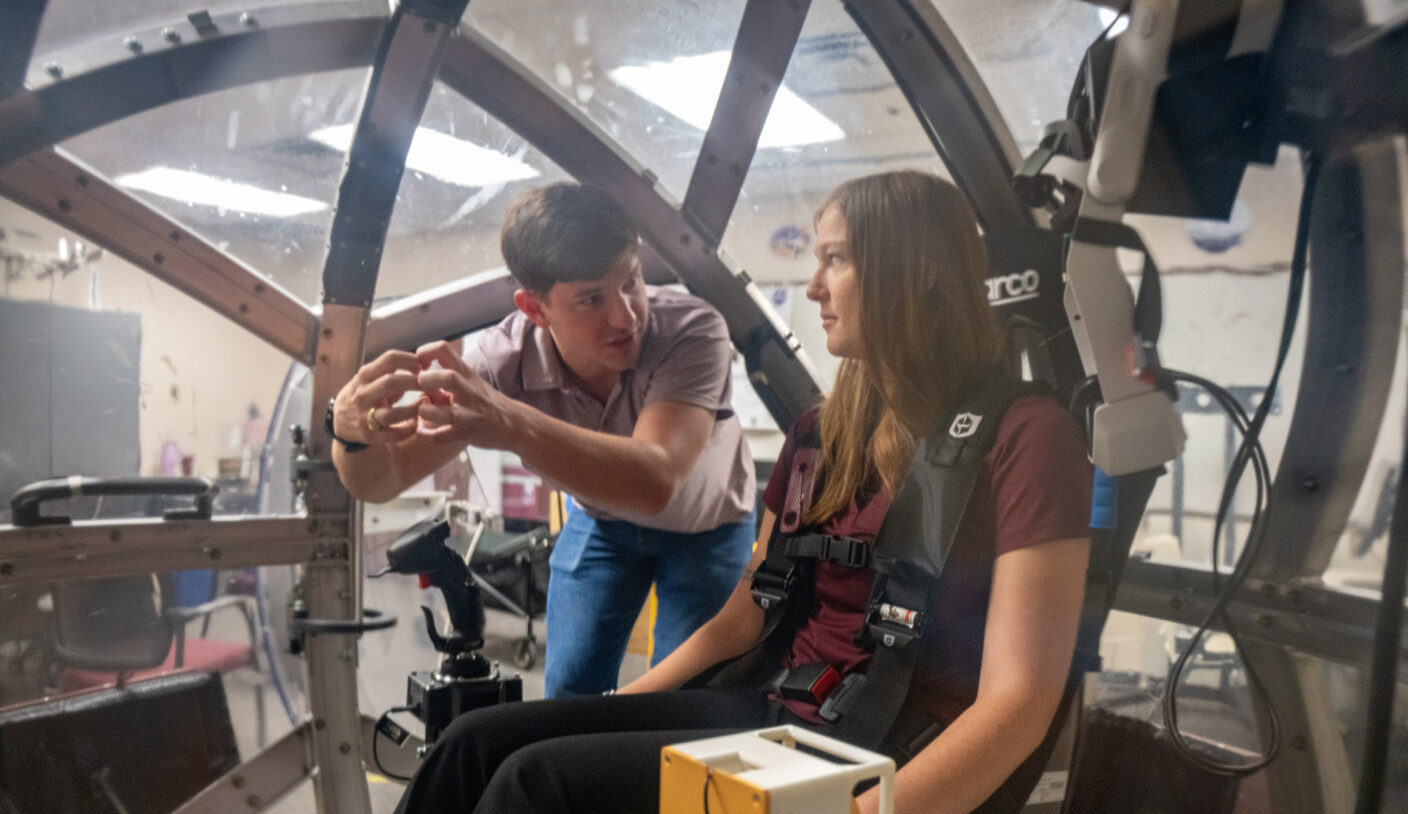
GVS mimics the disorientation of microgravity through electrodes positioned behind a subject’s ears.
The subject feels a cool blue gel, like the one used for ultrasounds, applied to the connection point. Hayes assists the subject into the Eight360 NOVA motion base — which looks like a human-sized hamster ball — and secures a virtual reality headset.
Hayes asks the subject if they are ready to begin. Approval is immediately followed by a disruption of balance and a feeling of unsteady ground. The subject knows the GVS is turned on, just as an astronaut knows they are in microgravity.
He then guides the subject through a simulated docking. Because GVS can mimic feelings of disorientation experienced in microgravity, this method could be used to prepare astronauts for space.
“GVS has been used to replicate and study many of the effects of microgravity that astronauts experience upon return from space. I wanted to use it to better understand how microgravity might affect performance while still in orbit,” said Hayes.
While the NSTGRO-funded project is going well now, Hayes’ transition wasn’t as smooth as it may seem. The first time he applied to the fellowship, he was rejected.
Hayes began his graduate studies under the guidance of Dr. Ranjana Mehta, focusing on human integration into engineering systems. Mehta played a crucial role in his early graduate experience, providing guidance and support as he transitioned from biology to engineering.
About two years into his engineering studies, in the summer of 2023, Hayes faced two major challenges: In addition to his NSTGRO fellowship rejection, Mehta was leaving the university.
His rejection from the fellowship meant his project would not be funded, and his advisor was leaving Texas A&M for the University of Wisconsin-Madison. Hayes could follow Mehta and continue his work from its current point or find a new faculty advisor at Texas A&M and restart his Ph.D. work.
Hayes had a tough decision to make.
Having already spent two years working on his research with Mehta, he was hesitant to take his research back to square one. His path had already taken a major turn when he switched disciplines. Would it be worthwhile to explore another detour?
He met with potential advisors — including former NASA astronaut and Texas A&M faculty member Dr. Nancy Currie-Gregg. In their first meeting, Currie-Gregg asked Hayes about his long-term goals.
“When I told her that I wanted to work in the space industry, Dr. Currie-Gregg pointed out that Texas A&M’s proximity to NASA provided opportunities for collaboration,” Hayes said. “This largely influenced my decision to stay.”
With Currie-Gregg as his new faculty advisor, Hayes joined the Safety in Aerospace and Flight Environments (SAFE) Lab, which aims to advance the health, performance, safety and efficiency of aviators and astronauts in high-risk environments.

As a new member of the SAFE Lab, Hayes reapplied for the NSTGRO fellowship with Currie-Gregg’s encouragement and a different approach. He met with NASA researchers to get a better understanding of what research gaps needed to be filled and implemented the information into his proposal.
Success.
His project, “Development and validation of a ground-based spacecraft docking simulator with vestibular perturbations,” joined the 2024 cohort.
The NSTGRO fellowship funds Hayes’ work with GVS and virtual reality systems to examine astronauts’ abilities to pilot and dock spacecraft.
“This funding allows me to pour more time into my Ph.D. work. I no longer need to spend 20 hours a week as a teaching or research assistant,” said Hayes.
This extra time to focus on his research has helped Hayes regain some of the time lost when he restarted his Ph.D. research.
Graduate students in the SAFE Lab are trusted and given the freedom to explore different ideas. Currie-Gregg supports Hayes, allowing him to explore tangential topics that enrich his research.
“I have a feeling I will never have a better student than John Hayes,” said Currie-Gregg. “He is the most intelligent student I’ve ever mentored. He is the hardest working student I’ve ever mentored. He is the most ingenious, hands-on, out of the box thinker. He’s the whole package.”
NSTGRO fellows also have the opportunity to work at a NASA facility for 10 weeks each year, contributing to active NASA projects.
This summer, Hayes spent 10 weeks at NASA Johnson Space Center in Houston working on a lunar lander simulator that Artemis IV astronauts will use to train for their planned moon landing. He also worked on the Johnson Space Center Engineering Orbital Dynamics (JEOD) software.
As Hayes prepares to graduate in 2027, the opportunity to work on the simulator and publicly accessible code gave him valuable experience in an industry setting and further honed his engineering skills.
Hayes plans to pursue a career at NASA, like his grandfather before him, and hopes to continue to work on addressing similar problems. When reflecting on the detours of his graduate career, Hayes emphasizes the importance of reaching out to others — whether it’s a potential mentor, mentee or colleague. He believes that connections open doors. “Throughout grad school, I have been blown away by people’s willingness to offer support if you just ask. I would definitely not be in the position that I am today without the incredible support of so many people.”